Whether you’re buying a used vehicle from a private seller or selling your own car in Colorado, preparing a Colorado Car Bill of Sale is one of the smartest steps you can take during the transaction.
A bill of sale creates a written record of the agreement between the buyer and seller. It documents important information such as the vehicle’s description, Vehicle Identification Number (VIN), purchase price, sale date, and the names of both parties.
Although the Colorado Division of Motor Vehicles (DMV) may require additional documents to complete a title transfer or registration, a bill of sale remains an important document that helps support the transaction and provides a reliable record for both parties.
On this page, you’ll learn:
- What a Colorado Car Bill of Sale is
- Why it’s important
- When you should use one
- What information should be included
- Colorado DMV requirements
- How to complete the form correctly
- Common mistakes to avoid
- Frequently asked questions
You’ll also find a printable Colorado Car Bill of Sale template that can be completed for your vehicle transaction.
What Is a Colorado Car Bill of Sale?
A Colorado Car Bill of Sale is a written document that records the transfer of ownership of a motor vehicle from one party to another.
It serves as proof that both the buyer and seller agreed to the terms of the transaction on a specific date.
A typical Colorado Car Bill of Sale includes:
- Buyer information
- Seller information
- Vehicle description
- Vehicle Identification Number (VIN)
- Purchase price
- Date of sale
- Odometer reading (when applicable)
- Payment information
- Signatures of both parties
While the bill of sale does not replace the vehicle title, it provides supporting documentation that helps verify the details of the transaction.
For private vehicle sales, keeping a completed bill of sale is considered a good practice because it creates a permanent record of the agreement.
Why Is a Colorado Car Bill of Sale Important?
A vehicle sale involves several important documents, and a bill of sale is one of the most useful records for both the buyer and seller.
It helps document the transaction clearly and can be referenced later if questions arise about the sale.
Creates a Written Record
A Colorado Car Bill of Sale documents:
- Buyer information
- Seller information
- Vehicle details
- VIN
- Purchase price
- Sale date
- Payment details
Having all of this information in one document helps both parties maintain organized records.
Supports the Title Transfer Process
- When ownership of a vehicle changes, the buyer generally completes the title transfer process through the Colorado DMV.
- A bill of sale serves as supporting documentation by recording when the vehicle changed ownership and who was involved in the transaction.
Helps Organize Vehicle Records
Maintaining copies of important vehicle documents helps buyers and sellers organize:
- Purchase history
- Ownership records
- Sale documentation
- Vehicle information
Good record keeping can make future paperwork much easier.
Reduces Misunderstandings
- A properly completed bill of sale records the agreed purchase price, sale date, and vehicle information.
- Because both parties sign the document, it helps reduce confusion about the terms of the transaction.
Supports Registration Paperwork
- After purchasing a vehicle, buyers typically complete registration through the Colorado DMV.
- A bill of sale may be kept alongside other required documents during this process.
Benefits of Using a Colorado Car Bill of Sale
Preparing a bill of sale before completing the transaction offers several practical advantages.
Documents the Transaction Clearly
Instead of relying on verbal agreements, both parties have a written record of the vehicle sale.
Keeps Important Information Together
The form organizes key transaction details, including:
- Buyer information
- Seller information
- Vehicle description
- VIN
- Purchase price
- Date of sale
- Payment details
Helps Track Ownership Changes
The bill of sale records when ownership changed and identifies the individuals involved in the transfer.
Supports Accurate Record Keeping
Keeping signed copies of the bill of sale helps both parties maintain documentation for future reference.
Easy to Complete
A professionally designed template provides clearly labeled sections, making it easier to enter information accurately.
Suitable for Many Vehicle Types
The same template can be used for various vehicle transactions, including:
- Passenger cars
- SUVs
- Pickup trucks
- Vans
- Hybrid vehicles
- Electric vehicles
- Classic cars
- Antique vehicles
Who Should Use a Colorado Car Bill of Sale?
A Colorado Car Bill of Sale is useful for anyone involved in a vehicle ownership transfer.
It is commonly used by:
Private Vehicle Sellers
Individuals selling their personal vehicles directly to another person.
Vehicle Buyers
Anyone purchasing a used vehicle from a private seller.
Family Members
People transferring ownership of a vehicle within the family.
Collectors
Buyers and sellers of collectible, antique, or classic automobiles.
Small Business Owners
Businesses selling company-owned vehicles.
Vehicle Enthusiasts
Individuals who frequently buy, restore, or sell vehicles.
Types of Vehicles Covered
A Colorado Car Bill of Sale can generally be used for:
- Cars
- Sedans
- SUVs
- Pickup trucks
- Vans
- Electric vehicles
- Hybrid vehicles
- Sports cars
- Antique vehicles
- Classic vehicles
Why Use a Professionally Designed Colorado Car Bill of Sale Template?
Using a professionally designed template helps ensure that all important transaction details are recorded in one place.
Instead of creating a document from scratch, you can complete clearly organized fields for:
- Buyer details
- Seller details
- Vehicle description
- VIN
- Purchase price
- Odometer reading
- Date of sale
- Payment information
- Signatures
A structured layout also makes the document easier to review, print, and store with your vehicle records.
Colorado Car Bill of Sale Form Template in Word, PDF
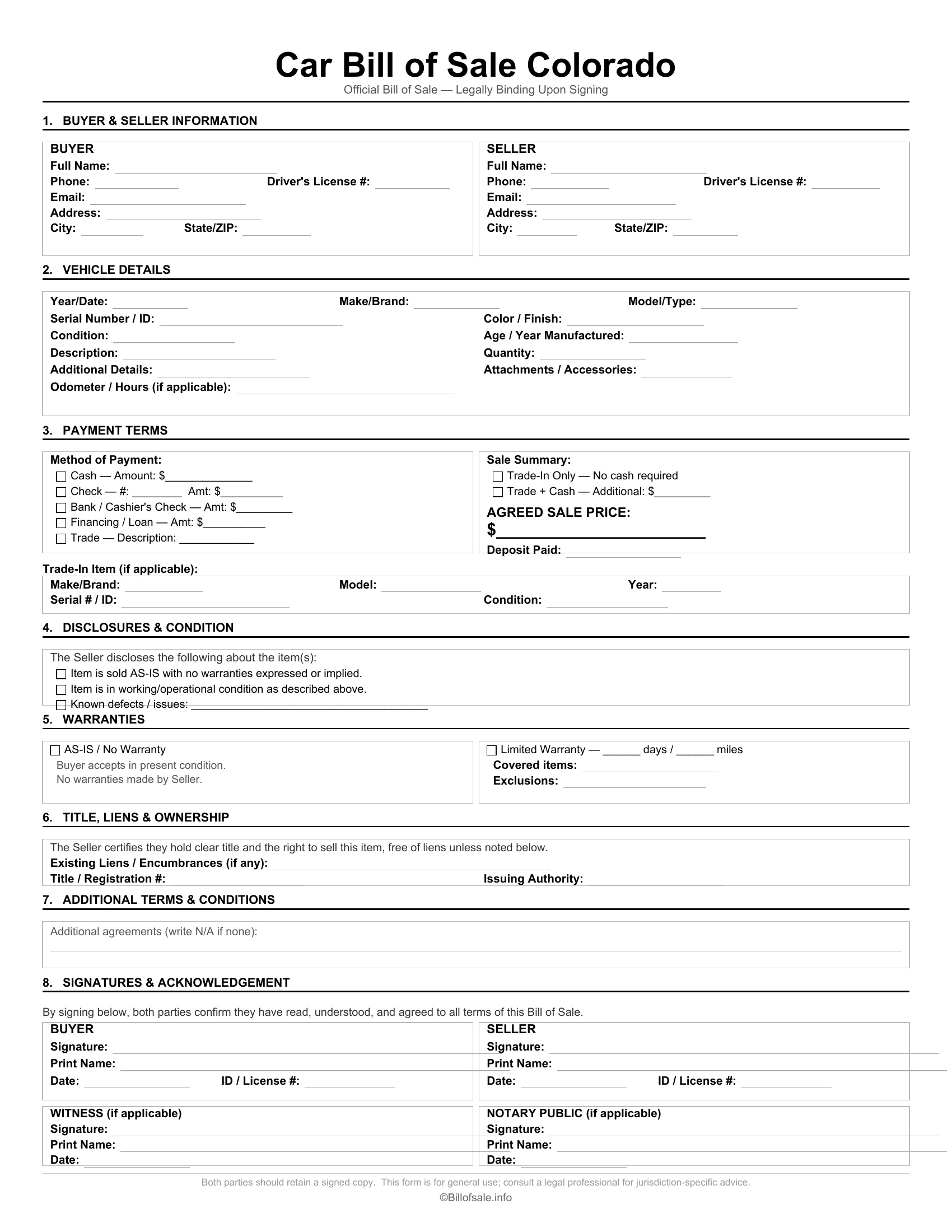
A prepared Colorado car bill of sale is commonly utilized in Colorado in the process of car title transfer in Colorado and car registration in Colorado. The Colorado car sale agreement helps both parties avoid confusion by clearly spelling out the car sale conditions in Colorado. A simple Colorado car bill of sale template, which contains all the necessary details needed to transfer the ownership of the car smoothly in Colorado, is preferred by many buyers and sellers.
When Do You Need a Colorado Car Bill of Sale?
A Colorado Car Bill of Sale is useful whenever a vehicle is being sold, purchased, or transferred between two parties. It provides a written record of the transaction and helps both the buyer and seller document important details about the vehicle transfer.
While the vehicle title is the primary document used to establish ownership, a bill of sale provides additional proof of the agreement and transaction details.
Some common situations where a Colorado Car Bill of Sale is used include:
Private Vehicle Sales
When a vehicle is sold directly between individuals, a bill of sale helps document the transaction.
It records important details such as:
- Buyer and seller information
- Vehicle description
- VIN
- Purchase price
- Date of sale
- Signatures
This helps both parties maintain a clear record of the private sale.
Buying a Used Vehicle
A buyer purchasing a used car from a private seller can use a bill of sale as supporting documentation.
It helps confirm:
- Who sold the vehicle
- Who purchased it
- The agreed price
- The date ownership changed
Keeping a copy provides additional documentation alongside the vehicle title.
Selling a Vehicle to Another Individual
A seller can use a bill of sale to document that the vehicle was transferred to the buyer.
It can help establish:
- The date of sale
- The agreed transaction amount
- The identity of the new owner
Vehicle Transfers Between Family Members
A bill of sale can also be useful when transferring a vehicle between family members.
Even if the vehicle is gifted or sold for a reduced amount, documenting the transfer helps maintain accurate ownership records.
Classic or Antique Vehicle Transactions
Collectors and enthusiasts often use detailed bills of sale when buying or selling classic vehicles.
These documents help record:
- Vehicle history
- Purchase price
- Condition details
- Ownership transfer information
Business Vehicle Sales
Businesses selling company-owned vehicles may use a bill of sale to maintain proper records of vehicle disposal or transfer.
What Information Should Be Included in a Colorado Car Bill of Sale?
A complete Colorado Car Bill of Sale should include enough information to clearly identify the vehicle, the buyer, the seller, and the terms of the transaction.
A properly completed form typically contains the following details:
Buyer Information
The buyer section identifies the person receiving ownership of the vehicle.
Include:
- Full legal name
- Address
- City
- State
- ZIP code
- Phone number (optional)
- Email address (optional)
Accurate buyer information helps establish who purchased the vehicle.
Seller Information
The seller section identifies the person transferring ownership.
Include:
- Full legal name
- Address
- City
- State
- ZIP code
- Contact information (optional)
The seller should verify that all details are correct before signing the document.
Vehicle Information
The vehicle description section provides details that identify the automobile being sold.
Common information includes:
- Vehicle year
- Make
- Model
- Body style
- Color
- Vehicle Identification Number (VIN)
- License plate information (if applicable)
Accurate vehicle details help prevent confusion during future paperwork.
Vehicle Identification Number (VIN)
The Vehicle Identification Number (VIN) is one of the most important details included on a Colorado Car Bill of Sale.
The VIN is a unique identifier assigned to each vehicle.
Before completing the form:
- Check the VIN on the vehicle
- Compare it with the title
- Confirm every character is accurate
A small error in the VIN can create problems during ownership transfer or registration.
Odometer Reading
The current mileage of the vehicle may need to be documented depending on the vehicle transfer requirements.
The odometer section may include:
- Current mileage
- Date of reading
- Odometer statement (when applicable)
Accurate mileage records help provide transparency about the vehicle's condition at the time of sale.
Purchase Price
The agreed purchase price should be clearly written on the bill of sale.
Include:
- Total sale amount
- Currency
- Payment terms (if applicable)
Recording the purchase price creates a clear financial record of the transaction.
Payment Method
The payment section can describe how the buyer paid for the vehicle.
Common payment methods include:
- Cash
- Check
- Certified funds
- Bank transfer
- Money order
- Other agreed methods
Including payment details can provide additional documentation of the transaction.
Date of Sale
The sale date identifies when the vehicle transaction took place.
This information can be useful for:
- Ownership records
- Title transfer documentation
- Tax records
- Personal records
Both parties should ensure the date is accurate before signing.
Vehicle Condition Information (Optional)
Some buyers and sellers choose to include details about the vehicle's condition.
This may include:
- Current condition
- Known issues
- Additional notes
- Agreement details
Adding condition information can provide additional clarity between both parties.
Signatures
The buyer and seller should sign the Colorado Car Bill of Sale after reviewing all information.
The signature section generally includes:
- Seller signature
- Buyer signature
- Printed names
- Date signed
Signatures confirm that both parties agree with the information recorded in the document.
Colorado DMV Bill of Sale Requirements
Many people ask:
"Does Colorado require a bill of sale for a vehicle?"
The requirements for vehicle documentation can depend on the type of transaction and the documents involved.
The Colorado Division of Motor Vehicles (DMV) generally uses documents such as the vehicle title and other required paperwork when processing ownership transfers.
A bill of sale is commonly used as supporting documentation because it records:
- The buyer and seller details
- Vehicle information
- Purchase price
- Date of transaction
- Agreement between both parties
Documents Commonly Used During a Colorado Vehicle Transfer
Depending on the situation, a vehicle transfer may involve documents such as:
- Signed vehicle title
- Bill of sale
- Odometer disclosure (when applicable)
- Proof of identification
- Insurance information
- Registration documents
- Applicable tax documentation
Requirements may vary depending on the vehicle type and transaction circumstances.
Colorado Title Transfer Overview
When buying a vehicle in Colorado, the buyer generally needs to complete the ownership transfer process through the Colorado DMV.
The process commonly includes:
- Obtaining the properly signed title.
- Completing required ownership transfer paperwork.
- Providing supporting documents.
- Paying applicable fees and taxes.
- Registering the vehicle.
A bill of sale helps provide additional documentation about the transaction details.
Tips Before Signing a Colorado Car Bill of Sale
Before completing the transaction, both parties should review the document carefully.
- Verify buyer information.
- Verify seller information.
- Confirm the VIN matches the vehicle title.
- Check the purchase price.
- Confirm the sale date.
- Review mileage information.
- Make sure signatures are completed.
- Keep copies of the signed document.
Why Complete Information Matters
- A Colorado Car Bill of Sale works best when all information is accurate and complete.
- Missing details or incorrect information can create confusion during future ownership questions, registration processes, or record reviews.
- Taking time to complete the form properly helps create a reliable record of the vehicle transaction.
Related Posts:
- Colorado Jet Ski Bill of Sale
- Colorado Boat Bill of Sale
- Colorado Trailer Bill of Sale
- Colorado Bicycle Bill of Sale
- Colorado Motorcycle Bill of Sale
How to Fill Out a Colorado Car Bill of Sale
Completing a Colorado Car Bill of Sale correctly helps both the buyer and seller maintain an accurate record of the vehicle transaction.
Before filling out the form, collect all necessary information related to the vehicle and both parties involved in the sale.
You should have:
- Buyer’s full name and address
- Seller’s full name and address
- Vehicle year, make, and model
- Vehicle Identification Number (VIN)
- Purchase price
- Date of sale
- Odometer reading (when applicable)
- Payment details
- Signatures from both parties
A properly completed bill of sale reduces confusion and provides a clear record of the agreement.
Step-by-Step Instructions for Completing a Colorado Car Bill of Sale
Step 1: Enter Seller Information
Start by completing the seller section.
Include:
- Full legal name
- Address
- City
- State
- ZIP code
- Contact details (optional)
The seller information should match the ownership details shown on the vehicle title.
Step 2: Add Buyer Information
Enter the buyer’s information accurately.
Include:
- Full legal name
- Address
- City
- State
- ZIP code
- Contact information (optional)
The buyer information identifies the person receiving ownership of the vehicle.
Step 3: Add Vehicle Details
Complete the vehicle information section carefully.
Include:
- Vehicle year
- Manufacturer/make
- Model
- Body type
- Color
- VIN
- License plate details (if applicable)
Always verify these details before signing.
Step 4: Record the Purchase Price
Enter the exact amount agreed upon by the buyer and seller.
The purchase price should clearly reflect the final transaction amount.
Example:
Vehicle Purchase Price: $8,500
Accurate pricing helps maintain a clear record of the sale.
Step 5: Add Payment Information
Document how the buyer paid for the vehicle.
Common payment methods include:
- Cash
- Check
- Bank transfer
- Certified funds
- Money order
Including payment details can provide additional evidence of the transaction.
Step 6: Complete Odometer Information
If applicable, enter the vehicle’s current mileage.
Check that:
- Mileage is accurate
- Numbers are easy to read
- Information matches other vehicle documents
Odometer information helps document the vehicle’s condition at the time of sale.
Step 7: Enter the Sale Date
The sale date represents when the vehicle transaction occurred.
Make sure the date is correct because it may be used for:
- Ownership records
- Registration documentation
- Personal records
Step 8: Add Additional Notes (Optional)
Some sellers and buyers may include additional information.
Examples:
- Vehicle sold as inspected
- Included accessories
- Additional agreements
- Condition notes
Only include information that is accurate and relevant.
Step 9: Sign the Document
After reviewing all information, both parties should sign the Colorado Car Bill of Sale.
The signature section generally includes:
- Buyer signature
- Seller signature
- Printed names
- Date signed
Each party should keep a copy of the completed document.
Colorado Title Transfer Process
When a vehicle is purchased in Colorado, ownership must generally be transferred from the seller to the buyer through the Colorado Division of Motor Vehicles (DMV).
The title transfer process usually involves completing the required paperwork and submitting the necessary documents.
Step 1: Obtain the Signed Vehicle Title
The seller should provide a properly completed vehicle title.
The title generally includes:
- Seller information
- Buyer information
- Vehicle details
- Required signatures
The buyer should verify that all information is accurate.
Step 2: Complete Required Ownership Documents
Depending on the transaction, additional documents may be required.
These may include:
- Bill of sale
- Odometer disclosure
- Title transfer paperwork
- Tax documentation
Step 3: Submit Documents to the DMV
- The buyer generally submits the required documents to the appropriate Colorado DMV office.
- The documents may be reviewed before ownership transfer is completed.
Step 4: Pay Applicable Fees and Taxes
Vehicle transfers may involve:
- Title fees
- Registration fees
- Applicable taxes
Fees can vary depending on factors such as vehicle type, location, and transaction details.
Step 5: Complete Registration
After ownership transfer, the buyer typically completes vehicle registration according to Colorado requirements.
Vehicle Registration in Colorado
After purchasing a vehicle, the new owner generally needs to register it with the Colorado DMV.
Registration confirms that the vehicle is legally recorded under the new owner’s information.
Common registration requirements may include:
- Signed vehicle title
- Proof of insurance
- Identification
- Ownership documents
- Applicable fees
- Tax payments
Requirements can vary depending on the buyer’s situation and county.
Colorado Odometer Disclosure Requirements
Odometer disclosure helps protect buyers by documenting the vehicle’s mileage at the time of transfer.
The disclosure may include:
- Current mileage
- Vehicle information
- Odometer statement
Accurate mileage reporting is important because it provides transparency about the vehicle’s history.
Some vehicles may have specific exemptions based on age or federal requirements.
VIN Verification in Colorado
The Vehicle Identification Number (VIN) is a unique identifier assigned to each vehicle.
Before completing a Colorado Car Bill of Sale:
- Verify the VIN on the vehicle
- Compare it with the title
- Confirm all characters match
Common places to find the VIN include:
- Driver-side dashboard
- Driver-side door frame
- Vehicle title
- Registration documents
Incorrect VIN information can create delays during paperwork processing.
Colorado Vehicle Sales Tax Information
Vehicle purchases in Colorado may involve applicable taxes based on state and local requirements.
The amount of tax may depend on factors such as:
- Purchase price
- Vehicle type
- Location of registration
- Applicable tax rules
Because tax requirements can change, buyers should confirm current information with Colorado authorities.
Registration Fees in Colorado
Vehicle registration fees can vary depending on:
- Vehicle type
- Weight
- County
- Registration category
- Additional options
Always check current Colorado DMV fee information before completing registration.
Private Vehicle Sale vs Dealer Purchase in Colorado
Understanding the difference between private sales and dealership purchases helps buyers know what documentation may be needed.
| Private Vehicle Sale | Dealer Purchase |
|---|---|
| Vehicle purchased directly from an individual | Vehicle purchased from a licensed dealership |
| Buyer and seller complete paperwork | Dealer usually prepares documents |
| Bill of sale commonly used as supporting record | Dealer provides purchase documents |
| Buyer handles transfer process | Dealer may assist with registration |
Required Documents Checklist for Colorado Vehicle Sale
Before completing a vehicle transaction, prepare the necessary documents.
Buyer Checklist
- Signed vehicle title
- Colorado Car Bill of Sale
- Proof of insurance
- Valid identification
- Registration documents
- Payment records
Seller Checklist
- Vehicle title
- Bill of sale copy
- Vehicle information
- Buyer details
- Transaction records
Common Mistakes to Avoid
Incorrect VIN Number
- A wrong VIN can create serious paperwork issues.
- Always compare the VIN with the vehicle title.
Missing Signatures
A bill of sale without required signatures may not properly document the agreement.
Incorrect Purchase Price
Always record the actual agreed amount.
Missing Buyer or Seller Information
Incomplete details can make ownership records unclear.
Not Keeping Copies
Both parties should keep a signed copy of the bill of sale.
Ignoring Title Requirements
- A bill of sale does not replace the vehicle title.
- Always complete the required title transfer process.
Legal Risks of Not Having a Bill of Sale
Although requirements may vary depending on the transaction, not documenting a vehicle sale can create unnecessary problems.
Without a written record:
- Sale details may be difficult to prove.
- Payment disagreements may occur.
- Ownership transfer dates may be unclear.
- Vehicle history documentation may be incomplete.
A completed Colorado Car Bill of Sale provides both parties with a clear record of the transaction.
Why Proper Documentation Matters
A vehicle transaction involves several important details, and keeping accurate records helps protect both buyers and sellers.
A properly completed Colorado Car Bill of Sale creates a reliable record of the agreement and can support smoother ownership transfer, registration, and future documentation needs.
Colorado Car Bill of Sale vs Vehicle Title
Many people confuse a Colorado Car Bill of Sale with a vehicle title, but both documents serve different purposes.
| Colorado Car Bill of Sale | Colorado Vehicle Title |
|---|---|
| Records the details of the vehicle transaction | Establishes legal ownership of the vehicle |
| Includes buyer and seller information | Shows the registered owner |
| Records purchase price and sale date | Used for official ownership transfer |
| Acts as supporting documentation | Required for title transfer process |
A bill of sale documents the agreement between the buyer and seller, while the vehicle title is the primary ownership document.
Colorado Car Bill of Sale vs Purchase Agreement
Although both documents relate to vehicle transactions, they are used at different stages.
| Colorado Car Bill of Sale | Purchase Agreement |
|---|---|
| Confirms the completed vehicle sale | Describes terms before final purchase |
| Usually completed during ownership transfer | Often used during negotiations |
| Records final transaction details | May include conditions and agreements |
A bill of sale is generally used as proof that the transaction has been completed.
Colorado Car Bill of Sale vs Vehicle Receipt
A vehicle receipt mainly confirms that payment was received.
A Colorado Car Bill of Sale provides more detailed transaction information, including:
- Buyer information
- Seller information
- Vehicle description
- VIN
- Purchase price
- Sale date
- Signatures
Because it contains more details, a bill of sale creates a stronger record of the vehicle transaction.
Is a Colorado Car Bill of Sale Legally Valid?
- Yes, a properly completed Colorado Car Bill of Sale can serve as written proof of a vehicle transaction between a buyer and seller.
- However, it is important to understand that a bill of sale does not replace the vehicle title.
- The title remains the primary document used to establish legal ownership and complete the official transfer process.
- A bill of sale works as supporting documentation by recording the details of the agreement.
Does a Colorado Car Bill of Sale Need to Be Notarized?
Not every vehicle transaction requires a notarized bill of sale.
However, certain documents involved in vehicle ownership transfers may have specific requirements depending on the situation.
Before completing your transaction, it is recommended to verify the latest requirements with the Colorado Division of Motor Vehicles (DMV).
Can I Use a Handwritten Bill of Sale in Colorado?
A handwritten bill of sale may be used if it contains complete and accurate transaction details.
However, using a structured template is often easier because it ensures important information is included, such as:
- Buyer details
- Seller details
- Vehicle information
- VIN
- Purchase price
- Sale date
- Signatures
A professional template reduces the chance of missing important information.
How Long Should You Keep a Colorado Car Bill of Sale?
Both the buyer and seller should keep a copy of the signed bill of sale for their records.
Keeping the document may help with:
- Ownership history
- Tax records
- Registration questions
- Future vehicle documentation
- Proof of transaction
Many people keep vehicle sale documents for several years after completing the transaction.
Why Choose Our Colorado Car Bill of Sale Template?
Our Colorado Car Bill of Sale template is designed to make vehicle transactions simple, organized, and easy to document.
Easy-to-Use Format
The template includes clearly labeled sections so users can quickly enter important transaction details.
Colorado-Focused Information
The form is designed around the common information needed for documenting vehicle sales in Colorado.
Printable PDF Format
The template can be printed and completed manually or filled out digitally before printing.
Complete Transaction Fields
The form includes sections for:
- Buyer information
- Seller information
- Vehicle details
- VIN
- Purchase price
- Odometer reading
- Payment method
- Sale date
- Signatures
Suitable for Different Vehicle Types
The template can be used for various vehicles, including:
- Cars
- Trucks
- SUVs
- Vans
- Electric vehicles
- Hybrid vehicles
- Classic cars
Product Features
Our Free Colorado Car Bill of Sale includes:
- Buyer information section
- Seller information section
- Vehicle description fields
- VIN section
- Purchase price field
- Payment details
- Odometer information section
- Sale date section
- Signature fields
- Printable layout
- Easy-to-complete format
Frequently Asked Questions
Q. What is a Colorado Car Bill of Sale?
A Colorado Car Bill of Sale is a document that records the sale and transfer of a motor vehicle between a buyer and seller.
Q. Is a bill of sale required for a car in Colorado?
Requirements can vary depending on the transaction. A bill of sale is commonly used as supporting documentation for recording vehicle sale details.
Q. Does Colorado require a bill of sale to transfer a vehicle?
The Colorado DMV may require different documents depending on the situation. A bill of sale can help document the transaction details.
Q. Can I download a free Colorado Car Bill of Sale?
Yes. A printable Colorado Car Bill of Sale template can be downloaded and completed for documenting a vehicle transaction.
Q. Does a bill of sale prove ownership in Colorado?
No. The vehicle title is the primary document that proves ownership. A bill of sale supports the transaction record.
Q. What information should a Colorado bill of sale include?
It should typically include:
- Buyer information
- Seller information
- Vehicle details
- VIN
- Purchase price
- Date of sale
- Signatures
Q. Do both buyer and seller need to sign the bill of sale?
Yes. Having both parties sign helps confirm agreement with the information recorded.
Q. Can I use a Colorado Car Bill of Sale for a used vehicle?
Yes. It can be used for documenting private sales of used vehicles.
Q. Is a bill of sale needed when selling a car privately in Colorado?
A bill of sale is commonly used during private vehicle transactions because it records the details of the agreement.
Q. Can a bill of sale replace a vehicle title?
No. A bill of sale does not replace the title. The title is required for official ownership transfer.
Q. What is the VIN on a bill of sale?
VIN stands for Vehicle Identification Number. It is a unique number used to identify a specific vehicle.
Q. Where can I find my vehicle VIN?
The VIN can usually be found:
- On the driver's side dashboard
- Inside the driver's door area
- Vehicle title documents
- Registration paperwork
Q. Should I include the vehicle mileage?
Including mileage is recommended when applicable because it documents the vehicle condition at the time of sale.

Romi Gupta is a content writer and documentation specialist focused on creating practical, easy-to-use legal and business templates. At BillofSale.info, Romi develops comprehensive guides and editable bill of sale templates that help individuals and businesses complete transactions with confidence. Her work emphasizes clarity, accuracy, and accessibility, making legal paperwork simpler for everyday users. Through detailed articles and downloadable PDF and editable templates, Romi aims to provide reliable resources for vehicle sales, personal property transfers, and other ownership transactions.